How does ASGI work?
This article is a very short introduction of ASGI, speficifcally, what is ASGI, how does it work and how can we use it.
What is ASGI and Why?
ASGI is the abbrevation of Asynchronous Server Gateway Interface, which is pretty much similar to WSGI, but in an async context. The reason that we need ASGI is very simple, we want to go async. WSGI was designed in such way that your python application can handle one request and send one response at one time. If you want keep-alive connection, just do long polling. If you need concurrent request handling, add more threads or use something like gevent. This works but they are not nativly shipped with python asyncio feature, in another word, in order to make async happen, you are making your web app heavier.
With ASGI, you can develop your app in fully async manner.
How to write a web service with ASGI?
The answer is simple, write code like this:
async def application(scope, receive, send):
    event = await receive()
    # Your business logics
    await send({"type": "websocket.send", ...})
And serve it with your favorite web server.
What does ASGI web server do?
Let’s take a very simple look at uvcorn’s source code.
First, a protocol is initialized. The protocol class is based on configurations
create_protocol = functools.partial(
            config.http_protocol_class,
             config=config,
             server_state=self.server_state
        )
The protocol is used to create service with python’s asyncio library by invoking
loop.create_server()
This will create a server that listens on a port. the first argument of this method is a protocol factory, which is a callable returning a protocol implementation.
Check this out for details of protocol interfaces.
The most important method here is data_received(data). This is the callback when some data is received. The main logic of web server.
 def data_received(self, data):
    self._unset_keepalive_if_required()
    self.conn.receive_data(data)
    self.handle_events()
It handles event when some data is received, let’s look at how the events are handled.
First of all, it build up a scope. Remember out simplest server? This scope is exactly same as that one. It includes necessary data to process a http request.
self.scope = {
    "type": "http",
    "asgi": {
        "version": self.config.asgi_version,
        "spec_version": "2.1",
    },
    "http_version": event.http_version.decode("ascii"),
    "server": self.server,
    "client": self.client,
    "scheme": self.scheme,
    "method": event.method.decode("ascii"),
    "root_path": self.root_path,
    "path": unquote(raw_path.decode("ascii")),
    "raw_path": raw_path,
    "query_string": query_string,
    "headers": self.headers,
}
Then it starts a task which invokes the ASGI function
task = self.loop.create_task(self.cycle.run_asgi(app))
task.add_done_callback(self.tasks.discard)
                self.tasks.add(task)
Inside the run_asgi method, it does this
async def run_asgi(self, app):
    try:
        result = await app(self.scope, self.receive, self.send)
Note that web server is responsible for implementing receive() and send() so that web application can focus on application layer protocols, i.e., HTTP or Web Socket
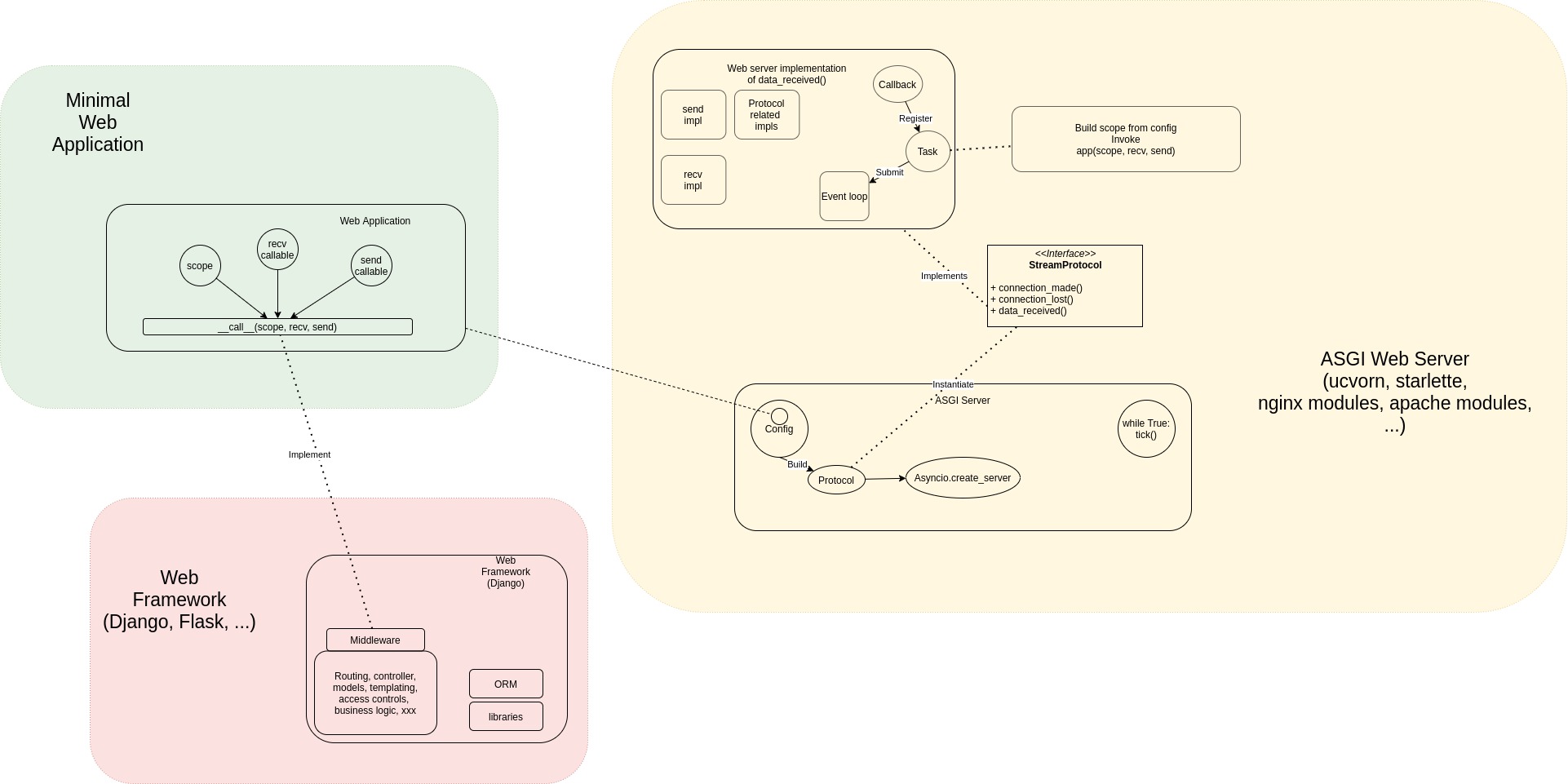
This Figure is a simplified demonstration of each roles in python’s web application stack.
Under the hood - asyncio
ASGI is powered by asyncio feature, and the core of asyncio is event loop. I read a few lines of Python3.7’s source code and think I can paste them here in order to explan what the fuck is inside of an event loop (Which is nowhere to be found in official doc).
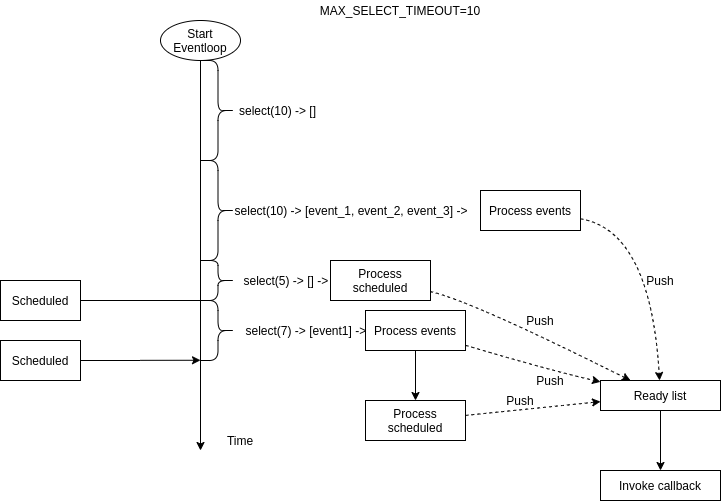
A typical event loop consists of couple of core roles:
- A
selectorwhich helps us to identify events that are ready to be processed. This is a system call, so we won’t discuss in detail here. - A
_scheduledlist which keep track of all scheduled handles. This is a priority queue of which the priority is defined by the actual time. That’s how we can pop out most urgent task. - A
_readylist, where ready tasks are stored. The callbacks of ready tasks are invoked at the end of each loop.
The event loop is started by calling loop.run_forever() method, which is simply a while loop calling _run_once(self) method. In side of _run_once(self), python does following things:
- Update scheduled list (If some handles are canceled, remove them)
- Calculate polling timeout.
- If loop is ready or stopped,
timeout=0 - else, timeout is the minimum of time to next scheduled event and
MAX_SELECT_TIMEOUT
- If loop is ready or stopped,
- If timeout is not 0, then invoke
selecton selector with timeout to get a list of events. - Process event first
- Then process scheduled handles
- Finally, invoke callbacks for handles in ready list
Following diagram is a simple explanation of this process